Credential Commons
Open tools to validate and publish credential and learning-outcome data against shared education ontologies — fast. Not a new ontology or portal; a thin interoperability + conformance layer that reuses and supports national vocabularies such as schema.edu.ee.
Why Credential Commons → How it fits with the standards →
npx credential-commons validate my-credential.jsonld
npx credential-commons export  my-credential.jsonld --to ctdl
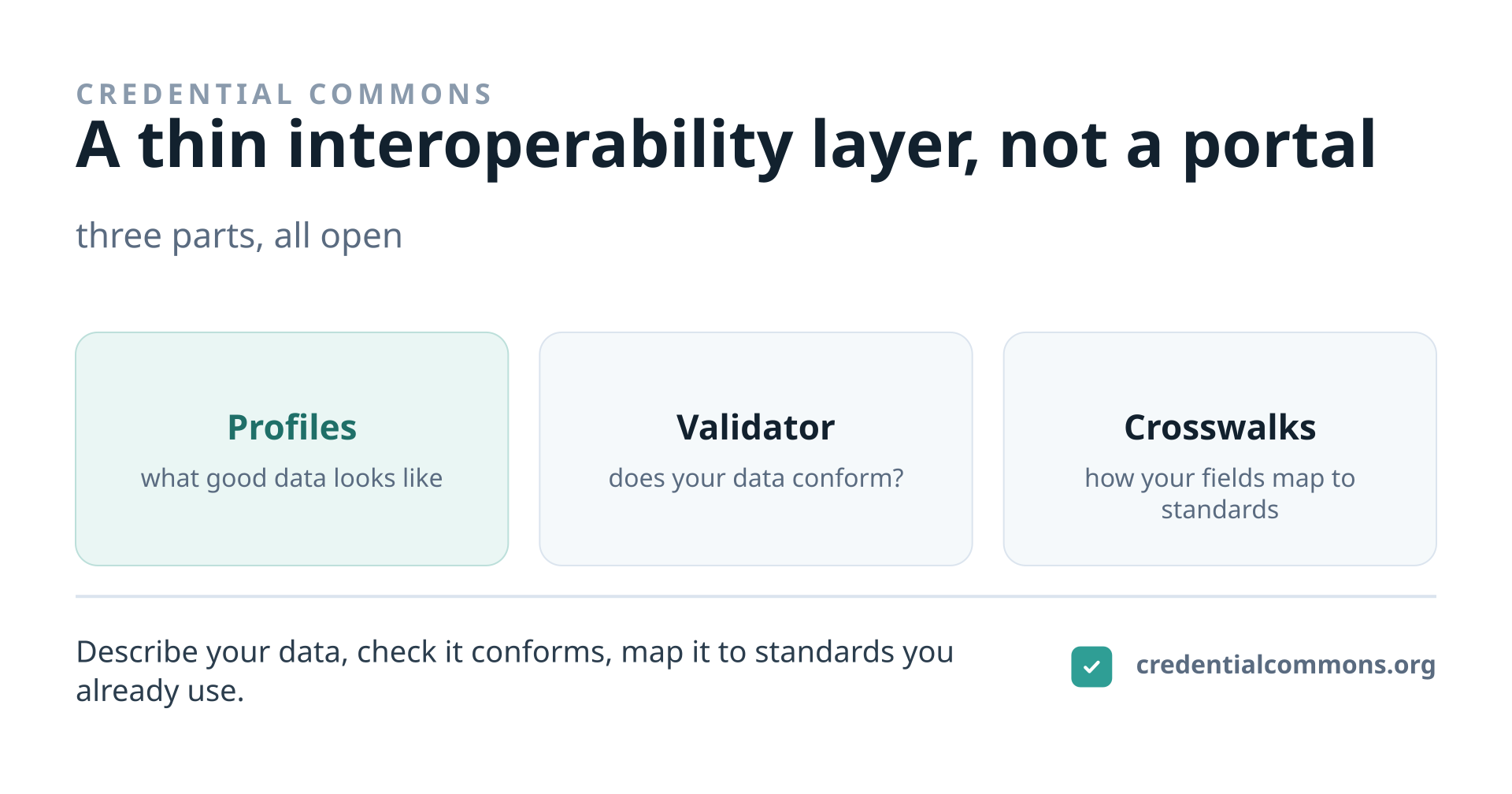
Profiles
JSON-LD context + SHACL rules — required vs recommended.
Validator
Plain-language conformance report; CI-ready.
Crosswalks
CTDL · ELM/Europass · Open Badges 3.0.
Reference data
250 real micro-qualifications, conformant.
GitHub repository · JSON-LD context · vocabulary · llms.txt · guide for AI agents
Why it matters & how to adopt: what travels (the idea) · integrate with your system · case: a public catalog · case: a training provider
Frequently asked
What is Credential Commons?
Credential Commons is an open, free toolkit — JSON-LD profiles, a SHACL validator and crosswalks — for validating and publishing credential and learning-outcome data against shared education ontologies. It is an interoperability and conformance layer, not a new ontology.
How do I validate credential or micro-credential data?
Describe your data as JSON-LD and run npx credential-commons validate . You get a plain-language report of what must be fixed (violations) and what is recommended (warnings); exit code 0 means conformant.
How is it different from CTDL, ELM/Europass or schema.edu.ee?
Those are the vocabularies; Credential Commons is the fast path to adopting them. It reuses schema.org and national vocabularies like schema.edu.ee, checks conformance, and crosswalks your data to CTDL and ELM/Europass rather than competing with them.
How is it different from W3C Verifiable Credentials or Open Badges?
A different layer, not a competitor. Verifiable Credentials and Open Badges 3.0 prove who issued a credential to which person; Credential Commons describes what the thing is — volume, language, outcomes, curriculum version — before anyone earns it. A signature proves authorship, not quality; Credential Commons is the check that runs first, and its records export straight to Open Badges 3.0.
Is it free, and what is the licence?
Yes. The code is Apache-2.0 and the profiles, contexts and crosswalks are CC-BY-4.0. There is no paid gate to being conformant — if npx credential-commons validate passes, your data is conformant.
How do I publish micro-credentials as Linked Data?
Add the Credential Commons JSON-LD context, include the required fields (name, ECTS/EAP credits, language, provider), validate, and serve the file at a stable HTTPS URL. The 10-minute quickstart walks through it.
Which competency framework or standard does Credential Commons use?
None is mandated. Credential Commons is a neutral commons: it defines the alignment slots and crosswalks, and you plug in whatever you use — ESCO, O*NET, EQF, a national framework, or your own. CC keeps the link interoperable; it never picks a favourite.
Does Credential Commons favour a particular product or vendor?
No. It reuses open mechanisms (schema.org, W3C Verifiable Credentials, JSON-LD, SHACL) and provides framework-agnostic slots. The crosswalks show how to map to standards like CTDL, ELM and Open Badges if you use them — not which to use. Staying open and pluralistic is the point.
How can an AI agent adopt Credential Commons?
Very fast — it is deliberately small and machine-readable. An agent reads the JSON-LD context and AGENTS.md, maps your offerings into the neutral slots, runs npx credential-commons validate to see exactly what is missing, and publishes one readable shape. It is built to be picked up in minutes.
Should I use CTDL, ELM/Europass, Open Badges or W3C Verifiable Credentials?
You do not have to choose blindly. Credential Commons is neutral: describe your data once and it crosswalks to CTDL, ELM/Europass and Open Badges 3.0 (W3C VC-compatible). Use whichever standard your audience already trusts — CC keeps the link interoperable.
How do I get my credentials recognised by other schools or employers?
Publish them in the shared Credential Commons shape at a stable URL. CC issues no stamp of its own — it is infrastructure, not an authority — but it makes your credential readable and portable, so the next school or employer can trust it and build on it instead of starting the learner over.
How do I check whether my credential or curriculum data is complete?
Run npx credential-commons validate . It works as a quality mirror, reporting exactly what is missing — a credit value, a learning outcome — so you know what to fix. Free, no sign-up.
How do I add skills or competencies to courses in a standard way?
Align each learning outcome to a competency in whatever framework you use — ESCO, EQF, O*NET, a national framework or your own — with the competency-alignment profile. CC mandates no framework; it just keeps the alignment link interoperable.
What is a micro-credential, and what data does it need?
A micro-credential (also called a micro-qualification or micro-degree) is a short, recognised unit of learning that certifies one skill or a small set. To be interoperable it needs a name, its volume (ECTS/EAP credits or study hours), the language, the provider, and its learning outcomes. Credential Commons defines exactly this shape and checks it for you.
I keep my courses in Word and Excel — how do I turn them into a proper, shareable curriculum?
You need no special software. Copy the essentials from your spreadsheet into one small JSON-LD file using the Credential Commons context — name, volume, language, provider, outcomes — then run npx credential-commons validate and publish it. An AI agent can do this straight from your Word or Excel in minutes; there is nothing to buy or install to be conformant.
We have a student information system — how do we make our credentials portable without replacing it?
Map, don't migrate. Keep your student information system and project a public, person-free Credential Commons view from it — the offering, its outcomes, the credential. CC is a thin portable layer on top, not a replacement, so your credentials become interoperable (and EU/Europass-ready) without changing your internals.
How do I make a micro-credential stackable, or part of a larger qualification?
Model each course as its own credential and compose courses into a programme or micro-qualification. Credential Commons has course, program and curriculum profiles for exactly this — a standalone course can also be a part of a larger qualification, and the composition stays machine-readable.
How do I align a micro-credential to an EQF level or to ESCO?
Put the level (e.g. EQF) on the credential, and align each learning outcome to a competency with the competency-alignment profile — ESCO, EQF, a national framework or your own. Credential Commons keeps the link interoperable and mandates no particular framework.