Why Credential Commons

A common language that lets a person's proven skills travel from one organisation to the next — so growth continues instead of starting over.
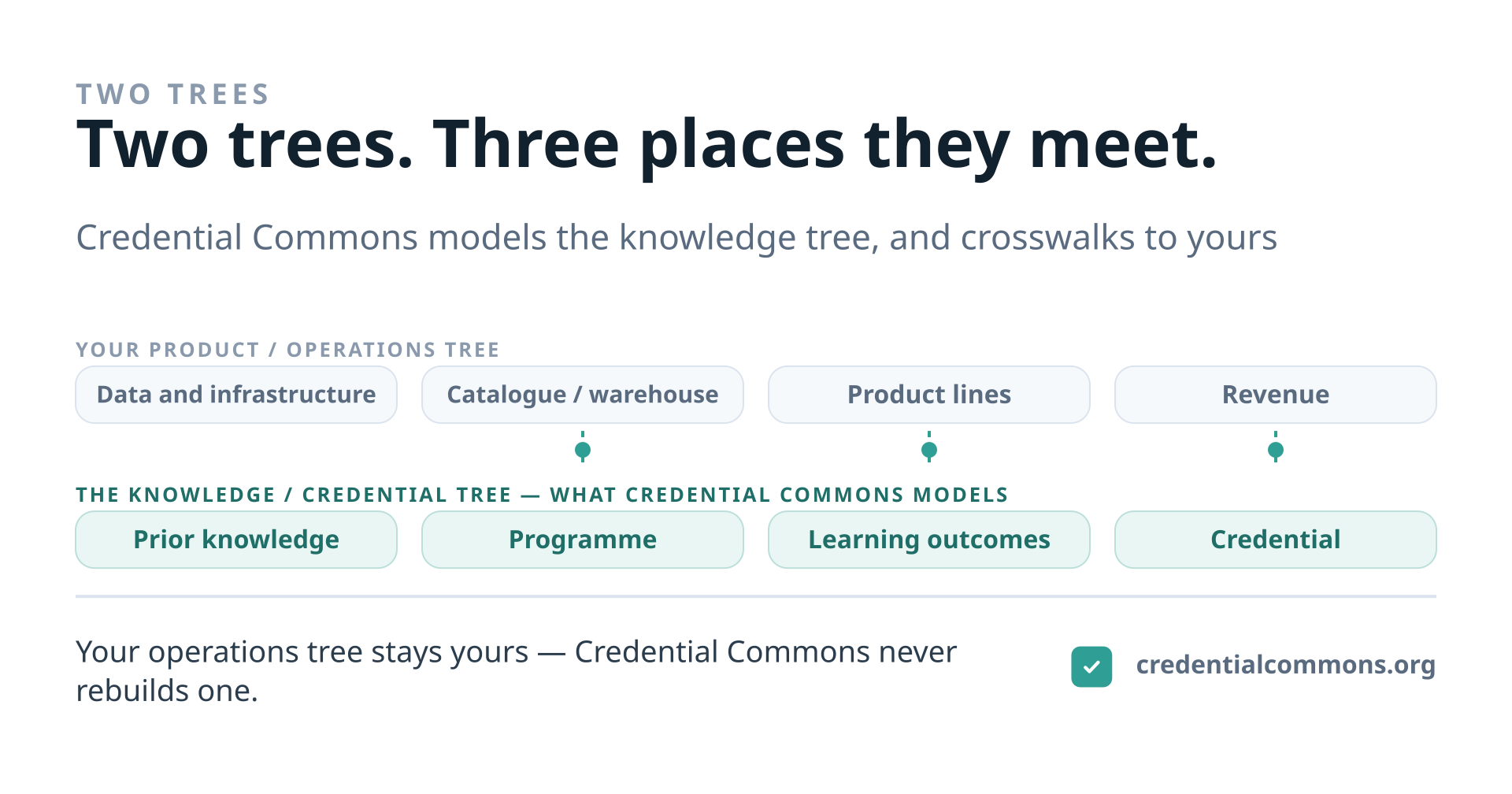
Two parallel tracks. The upper track is an organisation's product and operations tree: data and infrastructure, the catalogue or warehouse, product lines, revenue. The lower track is the knowledge and credential tree that Credential Commons models: prior knowledge, the programme, learning outcomes, the credential. Dashed links join the two tracks at three stages — the catalogue offering, the learning outcomes, and the credential. Credential Commons crosswalks to an operations tree at those points; it never owns or rebuilds one.
Two tracks: an operations tree and a knowledge tree, meeting at the catalogue offering, the learning outcomes and the credential.

Every school is a nursery

A training organisation helps one skill's seedling get a strong start. The learner owns the tree. Sooner or later it is transplanted — to another school, an employer, further into life — and grows on beyond the nursery's reach.
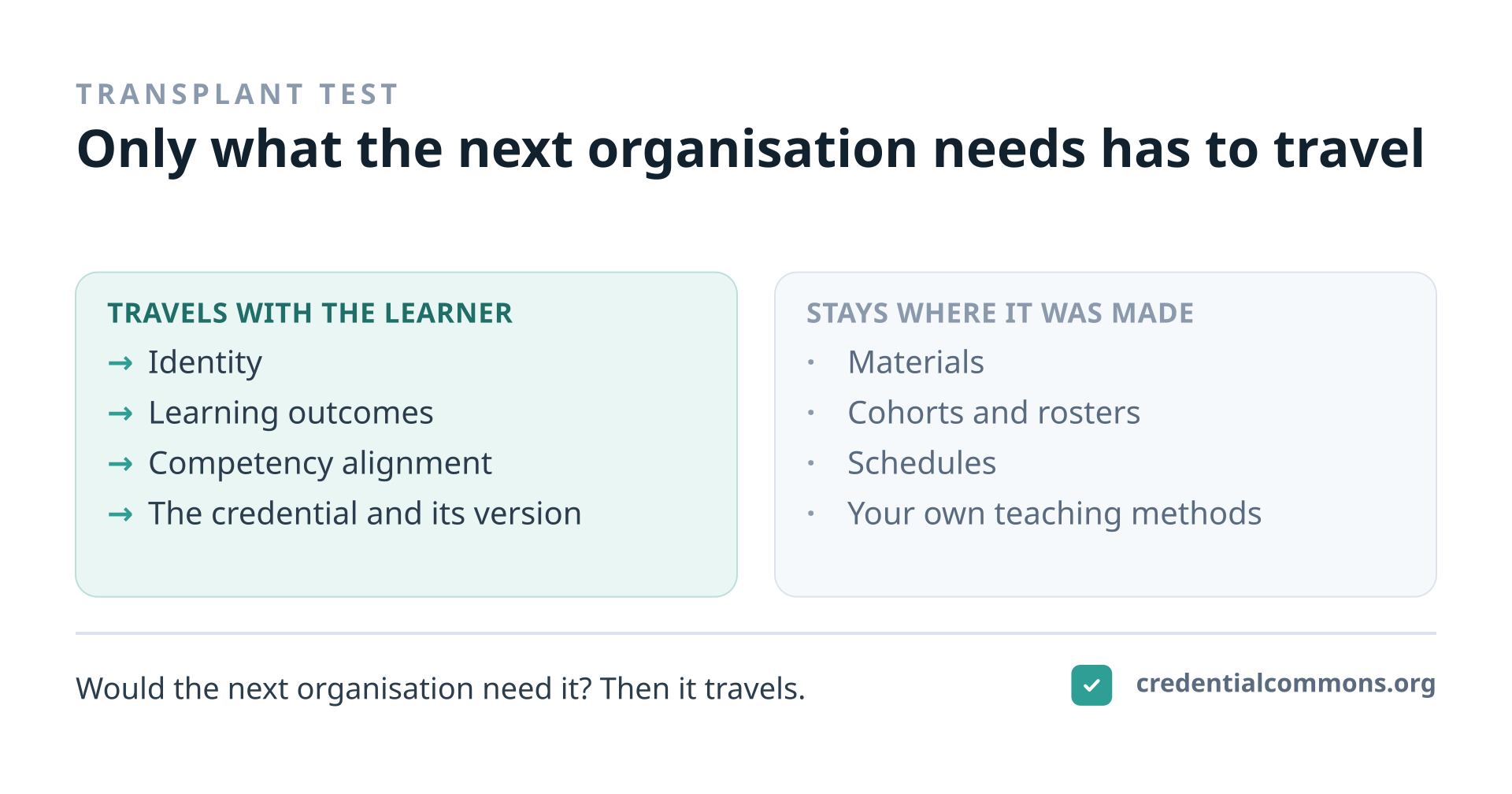
The transplant test decides what belongs in a shared credential record. One question: would the next organisation need this to recognise and continue the learner's growth? What travels: the learner's identity, the learning outcomes, the alignment to a competency framework, the credential or achievement itself, and the version the claim was made against. What stays behind: course materials, cohorts, rosters, schedules, and the organisation's own teaching methods. Credential Commons is deliberately small — it holds only what must survive the transplant.
The transplant test: what the next organisation needs travels with the learner; everything else stays where it was made.

The fruit and the label

The fruit is the learner's real knowledge and skills. A certificate does not replace the fruit — it is the label that makes it recognised, visible and trusted. But a label only works if the next organisation can read it.
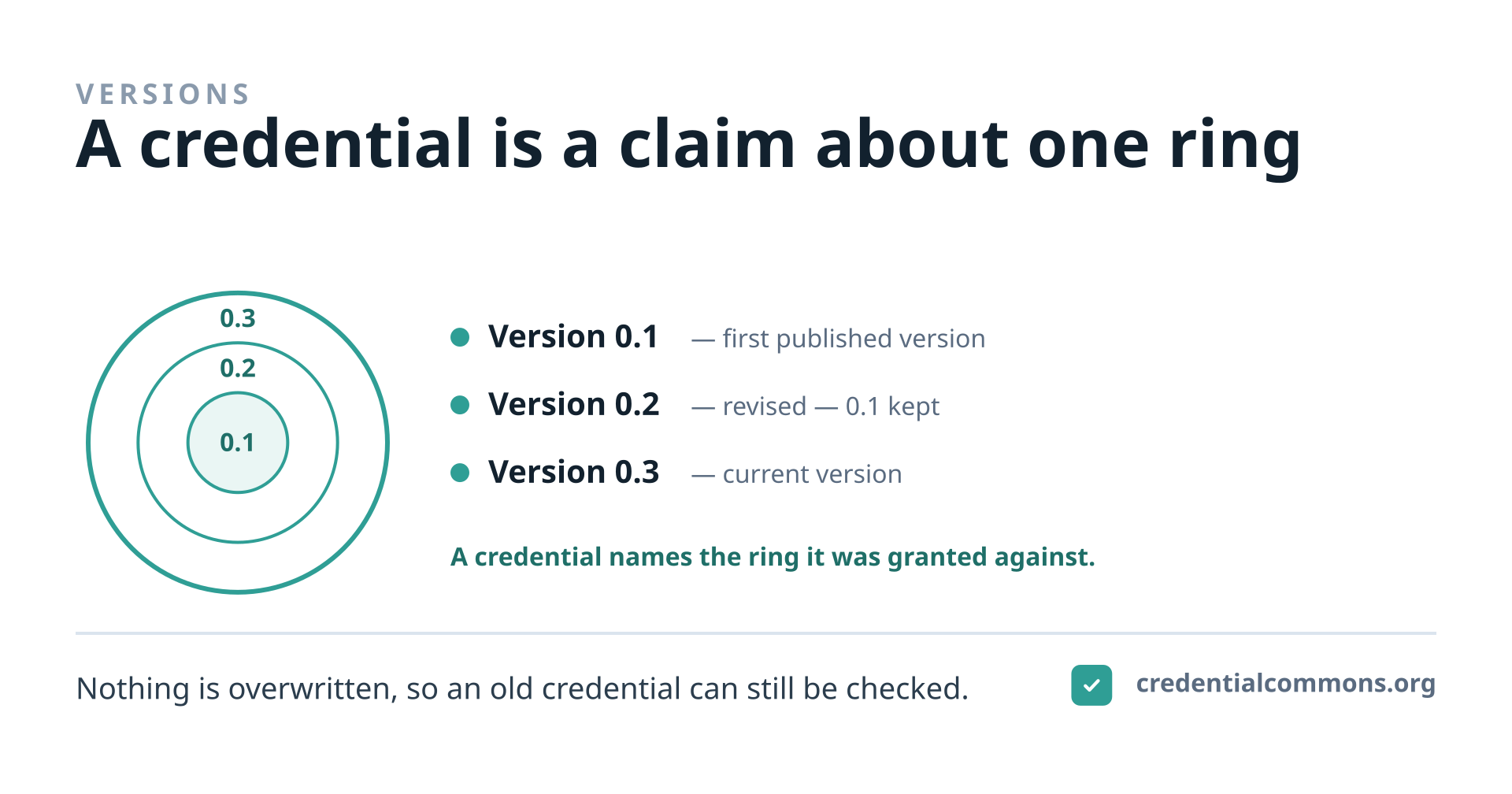
Versions modelled as growth rings. Each published version of a programme is one ring: it is retained and never overwritten by later versions. A credential is a claim about the specific ring it was granted against, so verifying an older credential means reading that ring rather than the current version of the programme. History is part of the model from the start, not a log added on afterwards.
Each version is a retained ring. A credential points at the ring it was granted against.

One shared language

Credential Commons is the shared language on the label. It is infrastructure, not an authority: it issues no stamp of its own, it carries each issuer's credential in a form anyone can read. And it is deliberately small — it holds only what must survive the transplant. Less is more: the smaller the core, the more places it fits.
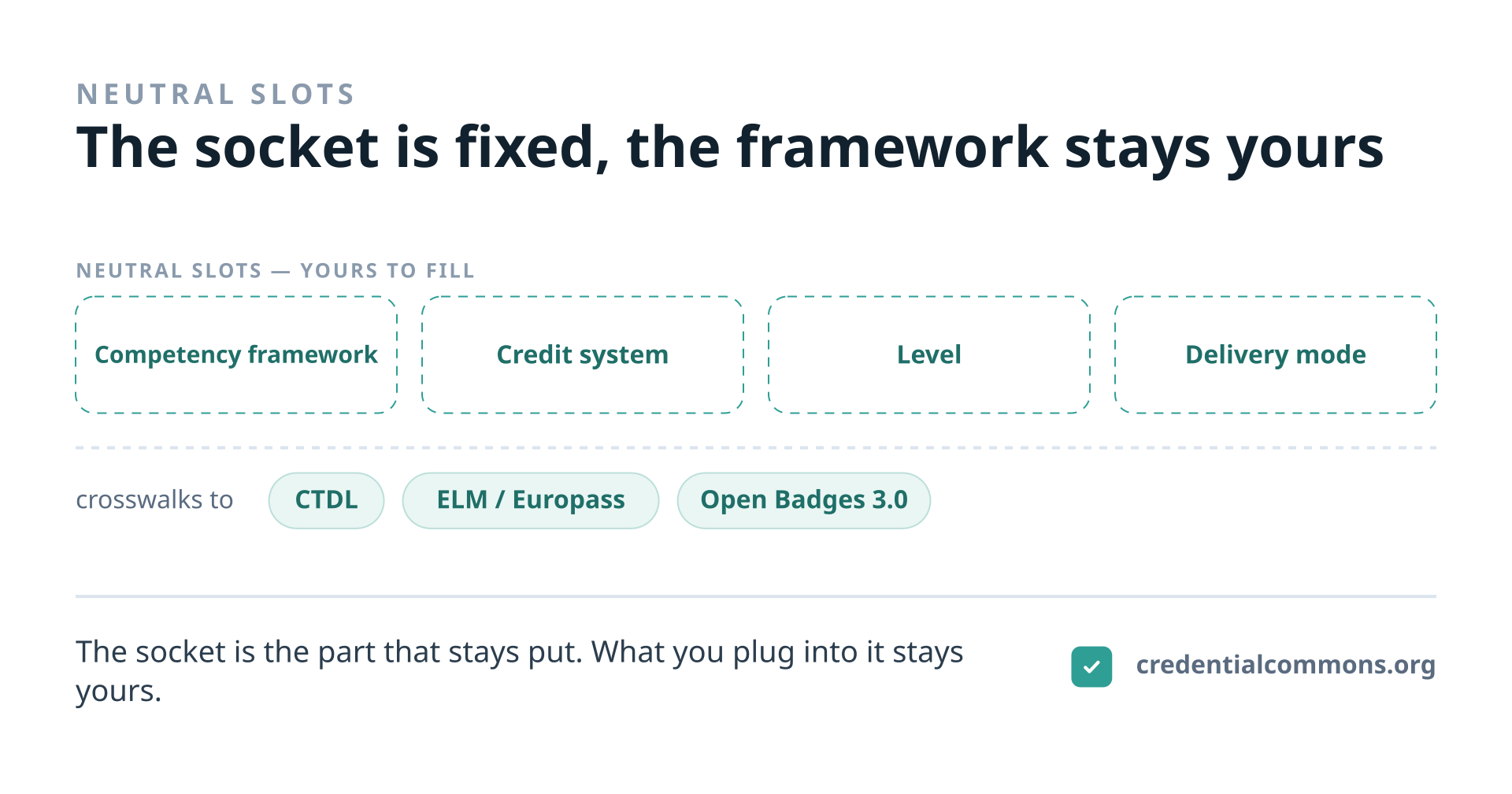
Credential Commons mandates no single vendor, product or framework. Where a layer needs an external model — a competency framework, a credit system, a level, a delivery mode — it defines a neutral, framework-agnostic slot plus a crosswalk mechanism. Adopters plug in whatever they already use, and the crosswalks describe how those fields map to CTDL, ELM/Europass and Open Badges 3.0. The crosswalks say how to map if you use these standards; they do not say to use them.
Neutral slots with crosswalks: Credential Commons defines the socket, not your choice of framework.

What each reader gets

For the learner

Wherever this language is spoken, your credential can be read and understood. You never start from zero. You carry proof anyone can read — and you save your time.

For a school — and its agent

Build on what a learner already grew, instead of replanting from seed. A new or transforming school can adopt the language in no time — even an AI agent can pick it up at once, organise a scattered system, and show exactly what is missing. Then your own system grows organically, the way a tree later grows more trees.

For employers and clients

A credential you can actually read and understand — because it speaks one language, and rests on data that was cleaned, not just claimed.

How to start

Run a training or an institution

Describe your offering once — an AI assistant can do it from your existing Word or Excel, or use a tool built on the standard. Validate for free, then publish. No new system to buy.

A learner

You set nothing up. Ask your provider to publish your credential in the standard — then it is portable and readable wherever you go next.

A developer or AI agent

Read AGENTS.md and the JSON-LD context, map your data into the neutral slots, and validate with one command. Built to be adopted in minutes.

So knowledge grows like a forest — one growth continuing the next — not like a single tree fenced inside one garden.